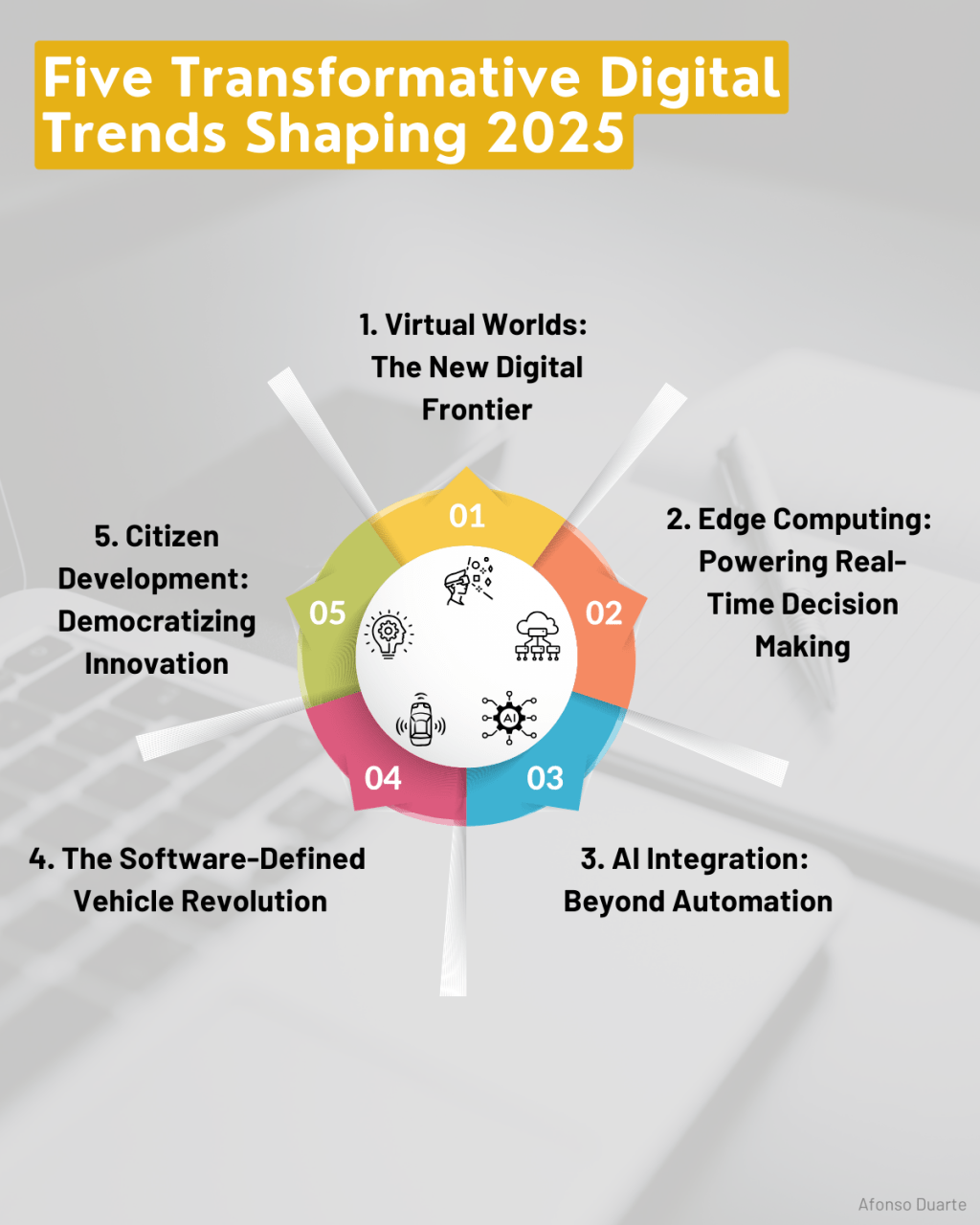
As we approach 2025, the digital landscape continues to evolve at an unprecedented pace, promising to revolutionize how we live, work, and interact. Here are five groundbreaking trends that will define our technological future.
1. Virtual Worlds: The New Digital Frontier
The concept of virtual worlds has evolved far beyond its gaming origins, emerging as a transformative force across multiple sectors. These immersive digital environments create spaces where physical and digital realities converge, offering unprecedented opportunities for interaction and innovation.
Perhaps most fundamentally, virtual worlds are revolutionizing how we interact with computers themselves. Traditional keyboard and mouse inputs are giving way to more intuitive, natural forms of interaction. Gesture controls, spatial computing, and haptic feedback systems are becoming the new norm, allowing users to manipulate digital objects as if they were physical ones. Information is no longer confined to flat screens but is instead presented in three-dimensional space, where users can physically walk through data visualizations, manipulate 3D models with their hands, and engage with content in ways that mirror natural human behavior.
In industry, virtual worlds are revolutionizing how businesses operate. Engineers now collaborate on complex prototypes in shared virtual spaces, while architects walk clients through detailed digital renderings of future buildings before breaking ground. Manufacturing companies are leveraging these technologies to simulate entire production lines, optimizing efficiency and identifying potential issues before they arise in the physical world.
Healthcare has emerged as another pioneering field for virtual world applications. Surgeons are now practicing intricate procedures in risk-free virtual environments, while medical students explore anatomical structures with unprecedented detail and interaction. Perhaps most innovatively, mental health professionals are conducting therapy sessions in customized virtual spaces, creating controlled environments that help patients confront and overcome their challenges.
2. Edge Computing: Powering Real-Time Decision Making
As our world becomes increasingly connected, the limitations of traditional cloud computing are becoming apparent. Edge computing emerges as the solution, bringing computational power closer to data sources. This shift drastically reduces latency and enables split-second decision-making crucial for next-generation applications.
Smart cities are among the primary beneficiaries, utilizing edge computing to manage traffic flow, optimize energy consumption, and enhance public safety in real-time. The technology’s ability to process data locally has become indispensable for applications requiring instantaneous responses.
3. AI Integration: Beyond Automation
Artificial Intelligence has moved beyond simple automation to become a sophisticated partner in decision-making and creativity. Modern AI systems are now capable of generating original content, providing nuanced analysis, and offering predictive insights across industries.
What makes this evolution particularly significant is AI’s expanding role in addressing global challenges. From climate change modeling to precision healthcare, AI systems are tackling complex problems with unprecedented sophistication and accuracy.
4. The Software-Defined Vehicle Revolution
The automotive industry is undergoing its most significant transformation since the introduction of the assembly line. Modern vehicles are evolving into sophisticated computers on wheels, with software becoming as crucial as mechanical components.
These next-generation vehicles offer personalized experiences through AI-powered systems that adapt to individual driving patterns and preferences. Connected car technologies are enabling predictive maintenance, real-time navigation updates, and enhanced safety features that were unimaginable just a few years ago.
5. Citizen Development: Democratizing Innovation
Perhaps the most transformative trend is the democratization of technology through low-code and no-code platforms. This movement is breaking down traditional barriers to software development, enabling individuals across all professional backgrounds to create custom digital solutions.
Organizations are witnessing unprecedented innovation as employees from various departments develop applications tailored to their specific needs, accelerating digital transformation and fostering a culture of continuous improvement.
Looking Ahead
These trends represent more than just technological advancement; they signify a fundamental shift in how we interact with digital systems and each other. As we move toward 2025, organizations and individuals who embrace these changes will be best positioned to thrive in an increasingly digital world.
The convergence of these technologies promises to create new opportunities while solving long-standing challenges across industries. The key to success will lie not just in adopting these technologies, but in understanding how they can be integrated to create sustainable value for businesses and society at large.

 Ideias, Análises e Reflexões sobre o Ecossistema Digital