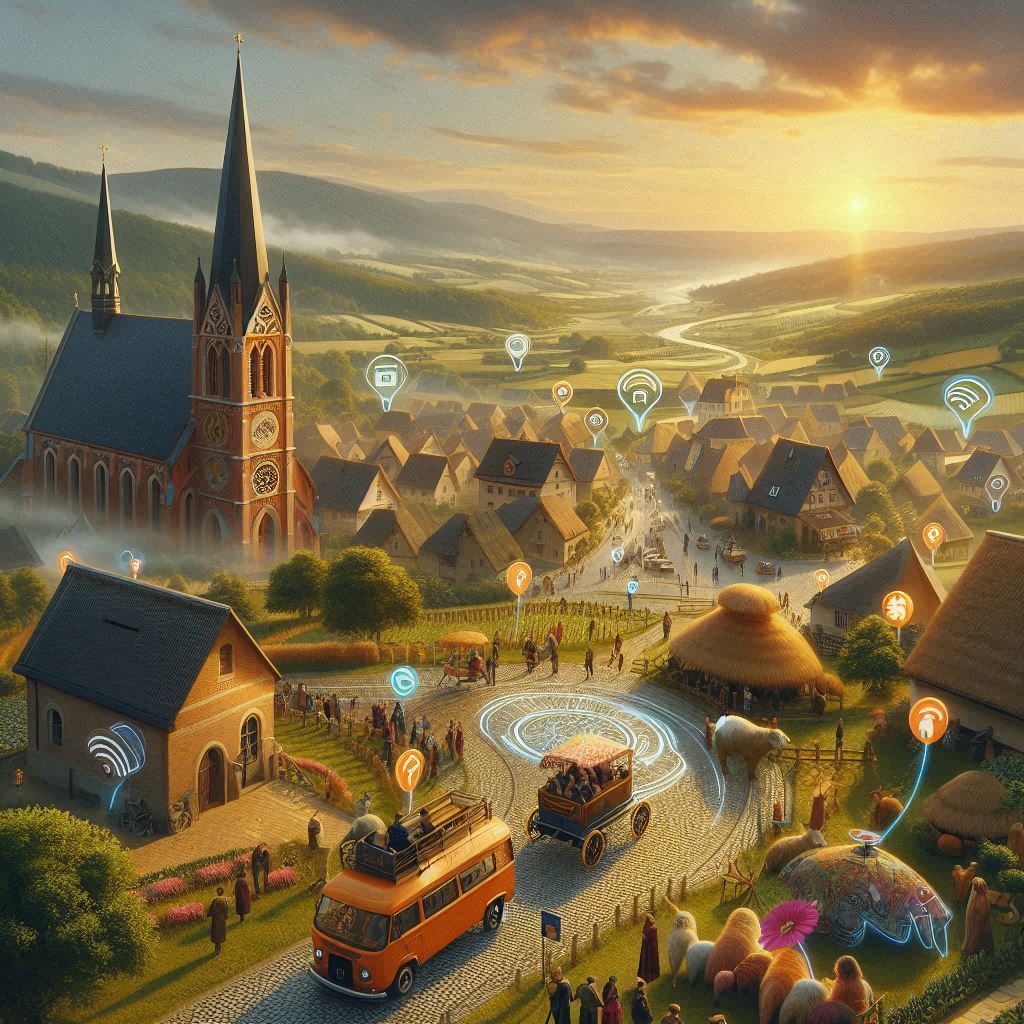
In the rolling hills of Innoventia, a quiet village nestled in the heart of rural Europe, life had always moved at its own pace. For generations, the residents had relied on their own vehicles or the occasional bus to navigate the winding country roads. But all that was about to change.
Maria, a spirited 70-year-old grandmother, stood at her garden gate, squinting at an unfamiliar sight rolling silently down the lane. It was a sleek, green vehicle with no driver, gliding to a stop right in front of her.
“Hop in, Grandma!” called out her grandson, Luca, from inside the vehicle. “It’s the new MobiGreen shuttle. It’s taking us to the farmer’s market in the next village.”
Hesitantly, Maria climbed aboard. The interior was spacious and bright, with a large screen displaying their route and estimated arrival time. As they set off, Luca explained how the new Mobility as a Service system worked.
“See, Grandma, it’s all connected. You can use an app on your phone or the community tablets in the village square to call a ride whenever you need one. It’s electric, so it’s good for the environment too!”
Maria listened, amazed at how technology was transforming their rural life. The shuttle picked up a young couple and their toddler along the way, and Maria realized she was seeing neighbors she hadn’t met before.
As weeks passed, Maria noticed changes beyond just easier transportation. The local grocery store, which had been struggling, was seeing more customers from neighboring villages. Young families were moving into once-empty houses, attracted by the improved connectivity that allowed them to work remotely while enjoying rural life.
One day, while waiting for a shuttle with her friend Elena, Maria noticed a group of workers installing solar panels on the roof of the village hall.
“Those panels will help power the charging stations for the shuttles,” Elena explained. “And look, they’re using drones to survey the land for new bike paths that will connect all the villages in our region.”
Elena, who worked at the local council, shared more about the economic impact. “The MobiGreen project has created new jobs in our area. We have technicians maintaining the vehicles and charging stations, IT specialists managing the booking system, and even a new tourist office to handle the increased visitors.”
Maria was surprised. “Visitors? To our little village?”
Elena nodded enthusiastically. “Yes! With the new mobility network, city dwellers are taking day trips to explore our countryside. It’s boosting our local businesses — the cafes, craft shops, even the old mill has been turned into a museum.”
The digital revolution wasn’t just changing transportation; it was reshaping the entire rural economy. Farmers were using smart sensors to optimize irrigation, reducing costs and increasing yields. The village school had virtual reality sets, allowing students to take virtual field trips to museums in Paris or coral reefs in Australia, improving education without the expense of travel.
But the transition wasn’t without challenges. Some older residents struggled with the technology, and there were concerns about data privacy and the reliability of the network in remote areas. Local taxi drivers and bus operators feared losing their livelihoods.
Recognizing these issues, the local council, supported by EU initiatives, organized digital literacy workshops. They also ensured that traditional methods of booking rides, like phone calls or in-person requests at the community center, remained available. The council worked with former taxi drivers to retrain them as MobiGreen operators and customer service representatives, ensuring they weren’t left behind in the transition.
As autumn arrived, bringing a golden hue to Innoventia ‘s forests, Maria found herself at the annual harvest festival. This year was different. People from villages across the region had easily made the journey thanks to the new mobility network, and the festival was larger than ever.
The festival buzzed with excitement as locals showcased how they were blending traditional rural life with new technologies. There were demonstrations of drone-assisted farming, virtual markets connecting local producers directly with city consumers, and an augmented reality game teaching children about local wildlife and conservation.
Maria was amazed to see a booth where young entrepreneurs were showcasing apps they’d developed to support the local economy — from a ride-sharing add-on for the MobiGreen system to a marketplace for local artisans to sell their crafts globally.
As she sampled some local cheese, Maria overheard a conversation between two farmers. They were discussing how the improved transportation had reduced their costs for getting products to market and opened up new opportunities for agritourism.
Maria smiled as she watched Luca excitedly explain to a group of city visitors how the MobiGreen system worked. She realized that their little village, far from being left behind, was at the forefront of a rural renaissance.
As the sun set, casting a warm glow over the festivities, Maria boarded a shuttle home. Looking out at the familiar landscape transformed by thoughtful innovation, she felt a sense of pride and hope. The wheels of change were indeed whispering through Innoventia , connecting its people not just to places, but to a sustainable, interconnected, and economically vibrant future.
This is the third, and last, Chapter of the Europe’s Digital and Green Ambitions Trilogy.
These stories are the fruit of a reflection on the impact of the European Digital and Green strategies. The purpose is to shed light into the objectives and expectations of the European strategies in these intertwined. Any character, city and action are fictitious. Image produced with the support of AI.
References:
Shaping Europe’s digital future — Green digital sector: https://bit.ly/3L7UGHL
How sustainable digital technologies could enable a carbon-neutral EU by 2050: https://bit.ly/4eJO9Rf
Towards a green & digital future (JRC study): https://bit.ly/3W3xHnF

 Ideias, Análises e Reflexões sobre o Ecossistema Digital